Tuesday, April 22, 2014

DOGS! (Pet a Pup: Library Study Break)

(I apologize right from the get-go for internet yelling at you in the title, but I'm super-excited about how well our program just went off! Plus, dogs are awesome.)

This week is finals week (yes, already!), and, while our computer labs and study rooms are definitely packed, we know that the bulk of the projects/group work/stressful assignments happen the week before finals. That is why we scheduled our "Pet a Pup: Library Study Break" program for Monday and Thursday of last week.  We contacted Paws & Effect and arranged to have their handlers bring in two therapy dogs in-training to help Grand View University students reduce their stress levels with a couple of study breaks. They came in on Monday 4/14/14 & Thursday 4/17/14.  I'll bore you with the details at the bottom of this post, but I wanted to give you a visual representation of how the program was received by students (and see more photos on our Facebook page):


Plus, our University Videographer, Todd Bailey, was amazing and came by early on during the Monday event, got some great footage, and put together this video by noon that same day! It was so nice to be able to send that out as publicity for Thursday's event!


Here are a few statistics:
Total Attendance
  • Attendees: 218
  • Surveys completed & returned: 171
  • 78% survey completion rate

Total Self-reported Stress Levels (Scale of 1-10 with 10 being extremely stressed, 1 being not stressed at all)
  • Average incoming stress level: 6.696
  • Average outgoing stress level: 3.204
  • Average decrease of stress level: 3.492

Responses to the Question: “Is this something you would like to see the library do again?”
  • 100% of respondents, 171 surveys, indicated, yes, this is something they would like to see the library do again. 
  • 0% indicated they were unsure of whether this event should continue in the future. 
  • 0% indicated they would not like to see this event continue in the future. 

How Students Learned of the Event (could indicate multiple)
  • 70% - Email (120)
  • 33% - Friend (57) 
  • 23% - Posters (40)
  • 15% - Grand Views (University Newspaper) Article (26)
  • 8% - Facebook (13)
  • 7% - I just happened to be around the library during the event (12)
  • 3% - Twitter (5)
  • 1% - Other (2)
(The social media numbers make sense, given we only just created our Facebook page after Thursday's event, and don't currently have a Twitter account for the library.)
And here are some of my favorite comments students wrote on their surveys:
  • <3 Paws & Effect
  • Bring more dogs!
  • Do it every month
  • Great idea! Good for the dogs AND students.
  • I had a great time with the dogs.
  • I love dogs & think having dogs around is a great stress reliever
  • I love dogs! GV should do it again!
  • I loved the dogs and this made me happy! :)
  • It's very calming.
  • Thank you! This is a fabulous event that I hope continues!
  • They were wonderful and very friendly. It was nice to relax with some dogs much like the one I have back home.
  • This is a WONDERFUL event! I love this idea. Thanks so much!
  • This is such a great idea! Please, please, do this again. Who doesn't love dogs? Plus it's a great way to get volunteers for Paws & Effect! 
  • Awesome idea-now if there was just a way to give every student a dog...
  • Do this more often, please!
  • Great idea! Do it at midterms, too! 
  • I love dogs they always make me smile and forget the bad things going on!
  • I think this is a wonderful way to relieve stress and also a way to gain knowledge about something unique. 
  • It was so nice having the dogs here! This should happen more often! :)
  • It's a great idea, especially black labs!!
  • LOVED IT (With a paw print drawn next to their comment) 
  • Thank you! It's a great way to break up a stressful time by seeing & petting the dogs. 
  • The pups were a great way to just relax and forget about school work
  • This is the best! We need more of this! (Is this something you'd like to see the library do again? Yes with “Please do it again!!!” written in.)
  • This was a great idea! I LOVE dogs and they made me feel so much better! <3
  • We should have dogs in the library all the time not just finals! :) Love it

I also want to say a big thank-you to the Psychology Club and the GV chapter of NAMI (National Alliance on Mental Illness) for their volunteer and financial help with this program! 

If anyone is interested in the nitty-gritty details of putting a program like this together (something I've been working on since December), I've tried to document everything along the way and am happy to share that information with you! 

Monday, April 7, 2014

Conference Recap: New Directions in Information Fluency, Augustana College

This past weekend my colleague, Dan, and I attended the first annual (hopefully!) New Directions in Information Fluency Conference at Augustana College in Rock Island, IL. I missed the Friday evening activities, but heard the dinner and library tour were great!

The morning began with registration, and then transitioned into the Keynote Address, given by Sandra Jamieson, Director of Writing Across the Curriculum and Professor of English at Drew University who is one of the principal researchers for The Citation Project. There were many great points drawn from the data, many of which weren't surprising to me, knowing students' research habits (i.e. most students cite from only the first page of the resources they use-46%, with other citations being drawn from page two-23%, and the next highest location within a source being cited is page 3-7.9%; 525 of the 930 sources cited were only cited once within the paper; 26% of the 1,911 citations in the student papers that were examined were less than or equal to 2 pages long) but it was nice to hear the data support what we already know (which can help us "prove" to our stakeholders that there is more to be done and we need to continue to work together to improve services). We know students will take the path of least resistance whenever possible; we know they'll chose topics they're already familiar with so it's easier to write the paper; we know they'll gravitate toward easy to find, short resources to cite in their papers. My interest is to further examine the data she quoted to see how we can use that to 1) modify the instruction we are already doing, and 2) use that data to help educate faculty about student research & writing habits. So often we see faculty assuming students arrive at college with the necessary skills to research, read (and understand) scholarly materials, and write well-constructed arguments. That's simply not the case, and now we have some great data to help faculty understand that if you want your students to do something, you have to teach them how.

Awesome group workstations and the circ. desk at Augustana's Thomas Tredway Library.
One term Jamieson and others used at the conference was "threshold concepts." Essentially, threshold concepts are those concepts students must have an understanding of before moving up to the next idea. Though this term wasn't one I use often, the idea behind it is a foundation in psychology (Maslow's Hierarchy of Needs), video games (level up), and common sense (you can't expect a music student to be able to play a scale if they haven't mastered the skill of how to hold the violin, the same is true with all areas of education--students must first have a strong foundation before moving to the next skill or concept).

Displays and work spaces at Tredway Library.
In the first panel after the keynote, Lucas A. Street (Assistant Director of the Reading/Writing Center) & Farah Marklevits (Instructor in English) both from Augustana College, presented "To Love Locked Rooms: First-Year Inquiry and Reading." They observed in their first-year writing class their students were having difficulty understanding scholarly resources. While they understand why it's important to summarize and paraphrase, they didn't always understand how to do it (especially with difficult reading). The instructors worked with the Writing Center to help the students bridge the gap between understanding and application. They revamped their trimester outline to emphasize how to understand difficult resources during the first trimester; then in the second trimester they focused on application of skills in a basic way to help convey the "They say" part of their text, They Say/I Say. In the third trimester they work to incorporate their own ideas to bring something new to the scholarly conversation (finding common themes among resources that help support their ideas).  They also have required tutoring session for those enrolled in a 1-credit library skills class, where students have individual, regularly scheduled "lessons" or tutoring sessions where they work to practice their skills. This is particularly helpful when students are struggling with paraphrasing and bringing together multiple sources to help reinforce their ideas. It allows the instructors time to focus on individual weaknesses, and to have the students talk about the resources (usually they are better when talking through a summary than when they are trying to write it out). It was nice that the presenters built in some time for conversation to brainstorm other ways to be sure students are able to apply the skills we are emphasizing in our instruction.

A close-up of the great group booths at Tredway Library. 
For the second half of the first panel, Virginia Johnson (Director of the Reading/Writing Center, also from Augustana) outlined her "Question Quest" activity in which students draft a research question (and why they're interested in that topic), practice reading-to-write strategies, revise their questions, and research about their topics.  They extract the paper writing process from the research paper, and just focus on the research process and understanding resources/how resources relate to their research question. Throughout the semester they journal and reflect upon the process. It reminded me of the article dissection activity I helped out with at University of Dubuque, where we focused only on understanding and incorporating sources into writing. There was only one thing for the students to worry about. This flips that and the "thing" to worry about it the research process (without a huge paper looming over students). I like the short assessment questions she uses with her students:
  • What did you learn about the library?
  • What did you learn about your research question?
  • How is this different from high school?
I think those three questions are easy for first-year students to understand, but provide faculty with feedback to allow for good reflection, helping faculty better understand just what the students got from the experience (and how they might apply it). 

Panoramic view of the first floor of Tredway Library.
After the first session, Dan & I, along with Nicole Cooke (faculty at Graduate School of Library and Information Science, University of Illinois at Urbana-Champaign), and Jennifer Sharkey (Milner Library, Illinois State University) presented on the "The Big Picture" panel.  Cooke talked about librarian education and ways to ensure librarians are prepared to teach (instruction training).  I liked that she is invested in improving librarian preparation to address instruction, and that she opened it up for dialog with the group to brainstorm ideas for how library schools can approach teaching. Sharkey discussed how Milner Library developed and implemented their information fluency plan. Then Dan & I discussed our embedded librarian program, and the process that helped us expand from a few English classes into the New Core. There were some great questions, and I hope those who attended were able to walk away with something they could use or think about for the future.

Green space and walkways on Augustana College's campus.
After our session was lunch, and then the final session of the day.  For my 2:00 session, I went to "Cultivating the One-Shot" given by University of Wisconsin - Eau Claire. I was impressed by this panel. They identified that they are limited to 1-shots, and so they decided to really hone in and perfect how they're approaching them.  Essentially, they went through a "Lesson Study" process where stakeholders from both the lesson content area and librarians worked together to set goals, design a lesson plan as a group, deliver the lesson plan while others observe (focusing on the lesson, not the instructor), discuss it, and then revise it to better meet the needs of the students/instructors. They broke it down into 2 primary goals (for their first-year courses):
  • Where can/should students search for various types of resources?
  • How can we recognize and demonstrate transferability of search skills? 
Throughout the process they'd deliver instruction, carefully observe/document the lesson in action, and conduct surveys/focus groups with the students.  

Then they described the "extras." Knowing you can't teach everything all at once, they created prerequisite tutorials for faculty to incorporate into their classes before they could request to come to the library for a 1-shot session. The great thing about this is, it's like a mini flipped classroom experience where students and faculty would/should have come in with a basic understanding from having gone through short video or online tutorials. A lesson learned from the presenters: it's key to be sure the technology you use to create the learning object should allow you to easily adapt, reuse, and create new versions of your materials.  

I also like the tiered lessons they mentioned, which is targeting a major (i.e. nursing) and following their course sequencing throughout the major to spiral instruction as they move into upper level classes. This way they get to build upon what they've done in the past, reduce repetition, and build relationships with students within a specific discipline. The presenter emphasized librarians adopting the major's language (i.e. PICO evaluation criteria as similar to Information Literacy evaluation criteria) to use within the planning and instruction process.  I'm looking at digging more into what they've made available through their libguides! 

 
Oh, you know. The usual TRICERATOPS at a library conference! We discovered this dino after our presentation. 

All in all, it was an interesting conference. There were many great conversations started and I was impressed with how smoothly things went, especially for this conference's first time out of the gate! One thing I would have preferred would have been to be able to attend more presentations. Many of the sessions have 5 panels to choose from (with 2-3 presentations within the panel).  I would have liked to have had more time slots with fewer concurrent sessions (maybe 3 to choose from instead of 5). Other than that, bravo, Augustana folks! 

Wednesday, March 19, 2014

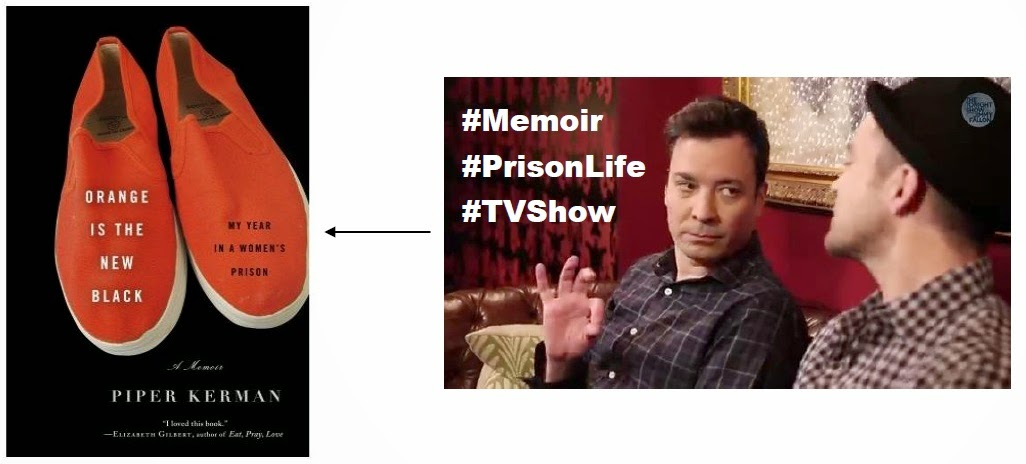
#Hashtag Book Displays

Here are some new materials I'm using to get students interested in our new leisure books. I hope you think they're #awesome.

All of the displays begin with this at the top:

#FunBooks #GVLeisureReads 
#Jimmy&JTBookReviews

We invited Justin Timberlake and Jimmy Fallon the review some of the new books we’ve added to the GV Library Leisure reading collection.

And then come the "reviews." Here are a few of my favorites, but you can read them all in the Scribd doc below.

(With this one I always picture them going "Was it you? Maybe you? You? Someone else? No really, you?")


Check out the memes #hashtagreviews replaced, or read the rest of the #hashtagreviews all in one document here:
Hashtag Book Reviews by stonca01

Monday, February 17, 2014

Annual Evaluation Time

The deadline for our annual evaluations has been extended a bit due to HR rolling out new software (there were a few glitches...). So, last week, I submitted my information. I have to admit, there were definitely a few things that made me giggle, particularly when the program scanned for language/replacement suggestions (see below).
This only reinforces my knowledge that computers are only as smart as the people who programmed them. It suggests I change "Young" to "lack of experience."

No, dear computer, I would not like to make it "lack of experience Adult Book Club."

Sunday, February 9, 2014

Snowy Second Semester Library Instruction

This semester has started of cold and snowy. Between pop-up blizzards, two rounds of a polar vortex coming through, and the fact that it is Iowa in the Jan./Feb., I think it is safe to say it is officially winter (and I think students, faculty, and staff are all feeling it).

This semester I am fortunate to be embedded with a wide variety of classes once again, as well as work with other classes on an individual-request basis.  I'm working with a Core Seminar I Class, two literature classes, an education technology course, and a sprinkling of biology, business, English, and nursing classes, among others.

It is always idea-inspiring to see how other instructors approach structuring, leading, and assessing their courses. (And we get the neat perspective of seeing a wide variety of disciplines/departments/content!) As library instructors, we ask for professors to contact us in advance and provide their assignment descriptions (and, if their students are choosing to research a wide variety of topics, examples of what they have chosen).  Instructors tend to also send along their syllabi, which helps give us further context when approaching lesson plan/activity development. Then, depending on the course, I may independently develop a lesson or work with my colleague, Dan, to brainstorm approaches together (or modify what might have been done in past semesters).

Here Dan is our a central coordinator, the initial contact for most instruction (particularly one-shot sessions), though instructors I have worked closely with in the past have contacted me and I have arranged for their sessions, as needed throughout the semester (we usually request they be in touch before the semester begins to get the session up on the calendar, but do accept requests throughout the semester). I know at other institutions, sometimes professors fill out an instruction request form instead of emailing.

Does anyone out there feel strongly one way or another which system works particularly well? Or has your library devised another system? I'm curious!

Friday, December 20, 2013

End of the Year Reflection

We've wrapped up another semester here. The students are home (or on the road to Rome, GA for the NAIA football championships), and things have gotten a little quieter around the library (at least for a few days).

Yesterday we held a summer book club winter gathering, an Apple Cider Lunch at the Library (instead of Lemonade Lunch at the Library), to talk about what we've read over the semester and just get together to celebrate having the time to get together after a busy term. It's nice to have the time to connect with students, staff, and faculty in a less formal way than the usual classroom and meeting interactions. 

A project I've been working on is starting to come to fruition for next semester: animal therapy dogs for that stressful time just before finals. I've gathered some information about other institutions and their use of therapy dogs, and have found some helpful articles as well. There is a local organization that trains service dogs and they have expressed initial interest in partnering for this, which I am really excited about. I think our students will love the program and it will help them de-stress before jumping back in to work on projects and studying for finals. 

This past semester was busy for everyone around the library with the roll out of the new college structure, committee involvement, increased class loads, etc., but it was great to work with so many students and help them be successful! 

Here are a couple quick shots of the new plaza, all lit up for the holidays:


And, because it's the end of the year and there are lists, here is my list (in no particular order) of top rated books on Goodreads from this year (though there's still time to add a few more... 11 days left):
  • The Snatchabook by Docherty, Helen (Adorable and perfect for young preschoolers' bedtimes.)
  • Persepolis 2: The Story of a Return (Persepolis, #3-4) by Satrapi, Marjane (better than the first, but you need the first to give you the context for the 2nd.)
  • Fortunately, the Milk by Gaiman, Neil (Charming for young readers and older readers alike.) 
  • Orange is the New Black: My Year in a Women's Prison by Kerman, Piper (I enjoyed this memoir more than I thought I would--better than the TV show.)
  • The Ocean at the End of the Lane by Gaiman, Neil (Again, charming!) 
  • Let's Pretend This Never Happened: A Mostly True Memoir by Lawson, Jenny (Funny, honest, worth your time)
  • American on Purpose: The Improbable Adventures of an Unlikely Patriot by Ferguson, Craig (I enjoyed this one more than I though I would--He is insightful, honest, and good at sharing his story with self-deprecating humor which makes him all the more human and the book all the more enjoyable.)
  • Let's Explore Diabetes with Owls by Sedaris, David (Duh. Go for the audio book, read by Sedaris himself.)
  • Aristotle and Dante Discover the Secrets of the Universe by Sáenz, Benjamin Alire (Loved this!) 
  • I Was Told There'd Be Cake by Crosley, Sloane (When she talked about toy dinosaurs under her sink, that was when I was hooked on this book.) 
  • The Evolution of Calpurnia Tate by Kelly, Jacqueline (I loved that this book was so empowering to young women interested in scientific inquiry!) 
  • Okay for Now by Schmidt, Gary D. (I loved the realism and honesty of the characters, the way they navigated and reacted to challenges, and just the way the whole story came together. Definitely worth your time!) 
  • The House of Tomorrow by Bognanni, Peter (I wasn't sure about this book when first I read the synopsis, but I found the characters to be so human and honest and engaging.)
  • Saving Graces: Finding Solace and Strength from Friends and Strangers by Edwards, Elizabeth (I was drawn to Edwards' honesty, her down-to-earth nature, and her humanizing flaws. Her writing draws you in and it feels almost as if she was just sharing her story with a friend. It was painful when it was supposed to be painful, hopeful when (had I been in her position) I would have found it beyond difficult to find hope, and honest and humble.)
  • Maus: A Survivor's Tale: My Father Bleeds History (Maus, #1) by Spiegelman, Art (Once I started I couldn't put this down. The way the story is portrayed is engaging and moving.) 
  • The Amber Spyglass (His Dark Materials, #3) by Pullman, Philip (Just read all three. Simply put, they are good.)
  • The Golden Compass (His Dark Materials, #1) by Pullman, Philip 

Wednesday, October 30, 2013

Fall on Campus

While today is a bit rainy and dreary out, earlier this week I was able to wander around campus and take a few photos of the changing leaves.  Below are a few of those snapshots, with one showing the final product of the plaza construction.