Showing posts with label disability. Show all posts

Monday, August 20, 2012

IULILColloq2012: Designing with Learners in Mind

The final session of the day was Christina Wray's (Center for Disability Information and Referral, Indiana University Bloomington) session" Designing with Learners in Mind: Utilizing Universal Design for Learning Principles in Library Instruction." Wray began by having attendees determine their learning style based on the descriptions she had on her handout (they boiled down to: imaginative, analytical thinker, hands-on learner, and spontaneous/free thinker).  This reinforced the idea that we all learn differently, but, if we design instruction to each all learners and intentionally plan beforehand, you're really avoiding creating "more work" later (rather than backtracking and reteaching, you're setting all types of learners up for success from the start).

  • "Universal design is not a trend, but an enduring design approach that assumes that the range of human ability is ordinary, not 'special.'" ~Elaine Ostroff
  • I love this quote Wray used because, in my "previous life" as a music teacher, I saw this all of the time--There is no "normal" way to learn.  No one approach to teaching will reach all learners, which is why it is crucial to approach each concept and skill from a variety of angles & present it to students in a way that engages them in multiple ways (see the three pillars below).
The Three Pillars of Universal Design for Learning (directly from Wray's handout)
  • Provide multiple, flexible methods of presentation
    • Provide options for perception
    • Provide options for language, mathematical expression and symbols
    • Provide options for comprehension
  • Provide multiple, flexible methods of action and expression
    • Provide options for physical action
    • Provide options for expression and communication
    • Provide options for executive functions
  • Provide multiple, flexible methods of engagement
    • Provide options for recruiting interest
    • Provide options for sustaining effort and persistence
    • Provide options for self-regulation
Many of the librarians who attended the session, including Wray, are at institutions that primarily deliver one-shot instruction sessions, which can sometimes make using Universal Design seem unrealistic given their time constraints.  Wray emphasized that Universal Design makes your instruction more efficient because you're actually doing a better job of reaching students & making the important concepts & skills "stick." I am very lucky to be at an institution that has a large and growing Embedded Librarian program, so I get to see many of the same students multiple times throughout the semester, and can take more time teaching (and therefore include a wider variety of approaches with) concepts and skills. 

Wray has compiled a delicious.com list of resources and links (and continues to add to this as new resources become available): http://delicious.com/ccwrayiub/iuilc

Here are a few that I put big ol' stars by in my notes:
I loved that this session and my teaching philosophy overlapped in many ways and I loved that we walked away with a ton of great resources to tap into when we got home! 

The IULILColloq2012 ended with some closing remarks and prizes... Some of the prize giveaways consisted of drawing names from hats, while the last one was a bit more...participatory.  Sometimes it can be hard to get librarians (even the crazy instruction librarians) to volunteer for activities... So I stepped up to the plate and raised my hand when Carrie Donovan asked for volunteers.  Little did I know I would be asked to read Standard 3 of the ACRL IL Standards aloud...in a (horribly executed) British accent (though I did do it with...errr...gusto?).  All in all, I had a blast at this year's IULILColloq and hope it is a tradition that continue! I know the date is already set for next year's: August 2, in the same place, New Albany, IN.  

Wednesday, April 27, 2011

Tech Article Discussion: Web Accessibility, Libraries, and the Law

Fulton, C. (2011). Web accessibility, libraries, and the law. Information Technology & Libraries, 30(1), 34-43. Retrieved from EBSCOhost.

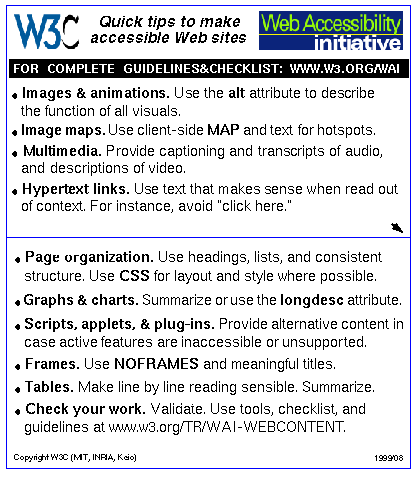
Last semester I took a course, Information Architecture for the Web, in which we spent a significant amount of time working to identify accessibility barriers on various websites and improve the accessibility of those websites we designed. We used a variety of resources to identify potential areas of weakness in our websites, and were able to meet with employees from the IU Adaptive Technology and Accessibility Centers (ATAC). They offer extensive services to those with disabilities as well as to those working with individuals with challenges. For our class, we discussed the obstacles various elements of web design might present as well as how the ATAC can help test and evaluate client websites to improve accessibility.

Fulton's article takes this one step further, examining federal laws and state statutes for web accessibility. She examines three assumptions:
  • Although the federal government has no web accessibility laws in place for the general public, most states legalized web accessibility for their respective agencies.
  • Most state statutes do not mention Section 508 of the Americans with Disabilities Act (ADA) or acknowledge World Wide Web Consortium (W3C) standards.
  • Most libraries are not included as entities that must comply with state web accessibility statutes.
While the Individuals with Disabilities Education Act (IDEA) does require schools and colleges to provide access to education resources, it does not require libraries to support this with their web presence. Issues of accessibility will continue to rise as library web services continue to grow and replace "traditional" print resources. It has fallen to individual states to define when and how accessibility standards should be implemented and enforced. Section 504 prevents the exclusion of those with disabilities "from programs or activities that are funded by federal dollars" and notes specific examples; because web accessibility is not addressed, state employees must analyze and interpret the law.

After examining each state's government websites for web accessibility standards (as opposed to building accessibility), Fulton compiled a list and addressed the three assumptions listed above. The first discussed state web accessibility standards; Fulton found 17 states have laws about web accessibility with only four with coverage including institutions receiving state funds. Others have established guidelines another way (except for Alaska and Wyoming, which had no accessibility standards available online). The second assumption was found to be true; Fulton found only seven states which directly address Section 508 or the W3C Web Content Accessibility Guidelines 1.0 (with only Minnesota referencing the more recent W3C WCAG 2.0). The last assumption, regarding libraries not being required to comply to state web accessibility standards, was also found to be true. Only Arkansas, California, Kentucky, and Montana require accessibility compliance in order to receive state funds; university libraries in Illinois, Oklahoma, Texas, and Virginia are required to have their websites at the same level as their state agency websites.

There are many barriers related to the time and finances it takes to make websites accessible; however, by not following accessibility standards approximately 24.5 million people around the United States have difficulties accessing the information they need. Reaching and serving patrons with disabilities should be approached as embracing a new way of thinking, not as a hassle. Accommodating those with special needs is more than just providing accessible physical spaces. The author notes, "Lack of statutes or federal laws should not exempt libraries from providing equivalent access to all; it should drive libraries toward it."

Additional resources: